
My book, Shakespeare through Islamic Worlds, will be published at the end of this month. In advance of its release, I wanted to share a bit about what I discuss in the book. It’s common knowledge that Shakespeare doesn’t have any Muslims in his plays, but is that common knowledge accurate? Starting from this premise, I investigate the secret, hidden, fugitive, and spectral presence of Islam and Muslims in his works. An obvious place to begin might be Othello. A play whose subtitle, “Moor of Venice,” points to an Islamic background and backstory. Furthermore, the play’s first scene is as much preoccupied with the military threat of the Ottomans in the eastern Mediterranean as it is with the elopement of Othello and Desdemona. In addition to Othello I might also investigate The Merchant of Venice wherein the braggart Prince of Morocco vies for the hand of Portia, the rich heiress of Belmont. In Shakespeare’s time, the ruler of Morocco could only have been a Muslim, so even though his religion is not explicitly mentioned, geography does the important work of signaling and grafting religion onto his identity. After these two plays the terrain of my investigation becomes a bit more bumpy and murky, but I might next turn to The Tempest and its witch Sycorax, who is from Algiers. Like in my example of the Prince of Morocco, geography becomes the means through which to trace Islamic identity because Algiers was similarly a Muslim locale. That’s only three plays, however, and perhaps not enough to write a whole book about. What my brief run-through here emphasizes though is that Muslims are floating in and around the margins of Shakespeare’s corpus, especially in the fluid waters of the Muslim Mediterranean in which most of his plays are set but from which he has evacuated the Muslim presence. What I seek to do in the book, then, is look for the coded ways in which Islam and Muslims appear, especially in the ways that their presence is signaled through geography, which allows me to explore more than just the plays mentioned above.

Shakespeare through Islamic Worlds is in many ways a recuperative project, but it is not interested in recuperating Shakespeare (he doesn’t need it) or in making Shakespeare politically correct (that’s unnecessary); rather, this book seeks to recuperate the Muslims and Islamic cultures and societies from the margins to which Shakespeare summarily consigned them and to put them back into the geographies where they belonged and over which they exerted considerable and significant influence. One caveat that I want to mention here and that I note in the book is that I only cover one out of the many regions that Muslim cultures inhabited, that of the Mediterranean. It would have been an impossible task to write about the global reach and span of Islam. In the early modern period and indeed even now, the Mediterranean was a Muslim dominated sea. Islamicate societies stretched from the western Mediterranean of Morocco to the eastern Mediterranean of Egypt and the Ottoman Empire. Islamic geographic control of the region often resulted in European anxiety about increased Muslim expansion into Europe. This anxiety manifested in early modern drama in strategic reversals, where Europeans were the ones traveling into Islamic domains and then triumphing over those cultures. Notoriously, Shakespeare’s drama refuses all engagement with Islam, eschewing the kinds of acceptable, Euro- and Christo-centric scripts that his fellow playwrights seemed to favor. Instead, Shakespeare simply removes Islam and Muslims from the space of the Mediterranean, re-turning the geography to the control and dominance of European powers and Christianity.

Why would Shakespeare have wanted to do that? To erase Islam and Muslims from the world his plays depict, and world wherein they existed in reality if not in his imagination? These questions are not just about Shakespeare’s intentions or inclinations because Shakespeare is not just any writer. Shakespeare is the avatar of universal creative genius and a global author, whose works appeal to us across the centuries and speak to us in any space we inhabit. Some might even go so far as to say that Shakespeare invented what it means to be human (in fact, some have). If, then, Shakespeare is foundational to humanity, what does it mean that Shakespeare excludes Islam and Muslims from the representational frame? Are Muslims then inhuman? Additionally, what does it mean if Shakespeare doesn’t feature any characters who are explicitly identified as Muslim but then does use Islamicate cultures as tropes, symbols, and metaphors? Does that not demonstrate both the centrality of Islam and Muslims to the early modern English literary and cultural imagination and the impossibility of repressing or erasing these people and their cultures?
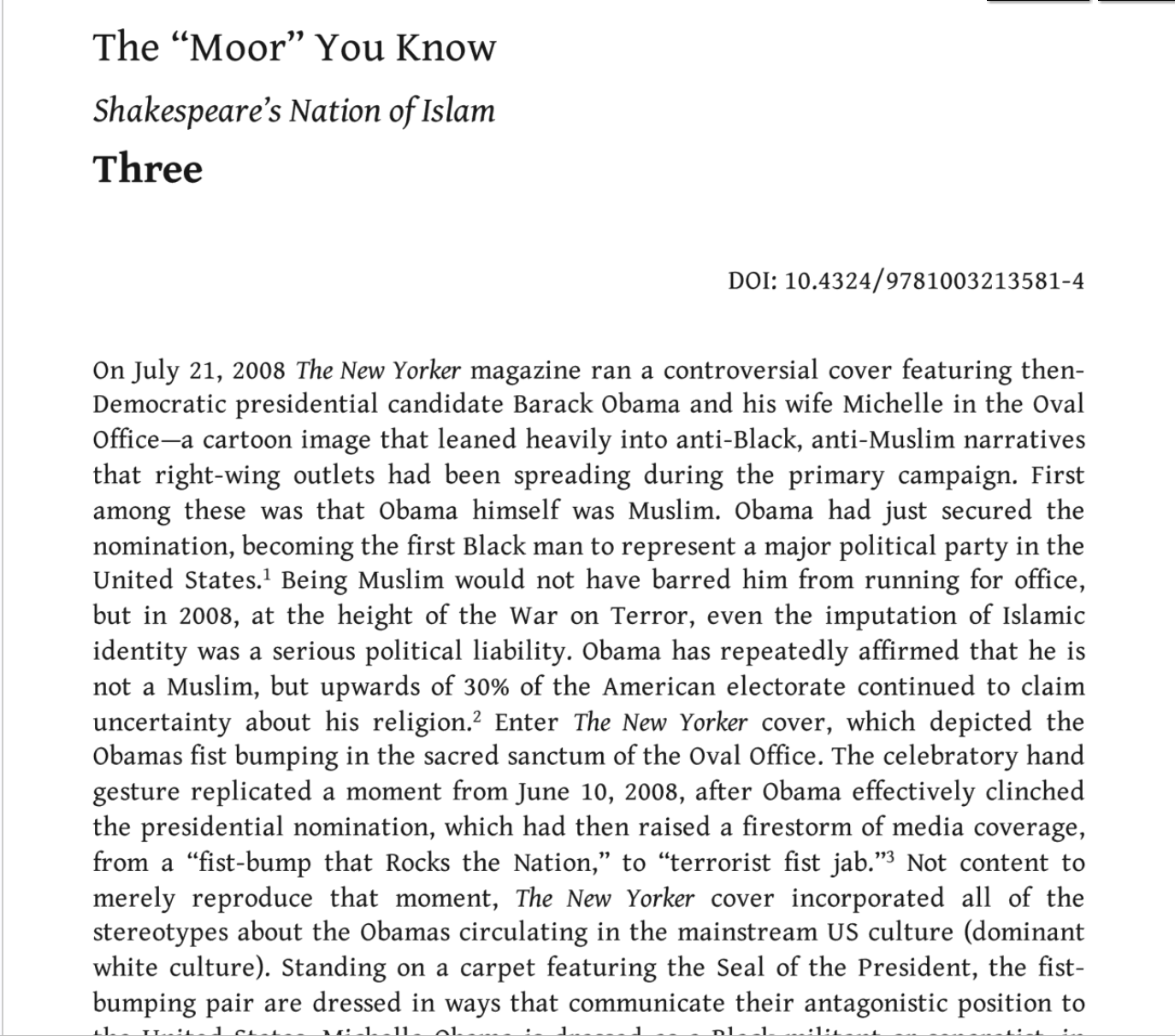
I explore and investigate these questions in Shakespeare through Islamic Worlds to show how Islam and its societies were foundational to early modern English and European self representation and to the construction of a white and Christian Europe.Consequently, my study emphasizes how race and religion intertwined in the representation of Muslim difference. Indeed, anti-Muslim racism, is a cornerstone of European racial formation and should be understood as institutional racism because of the laws established in the period that penalized and legislated Muslim life as well as the codes that relied upon bodily markers of difference, like Spain’s blood purity laws, that fixed religion in the body and established a racial hierarchy through such markings. Finally, I insist in Shakespeare through Islamic Worlds, that studies of Islam in the premodern period must substantively engage with Edward Said’s Orientalism. European and English discourses of Islam and Muslims rely upon demonizing and denigrating images of the religion and its people. These images construct the geographies of Muslims through east/west binary oppositions onto which are mapped other oppositions such as moral depravity/virtue, sexual license/chastity, physical darkness/whiteness, and damned faith/right religion among others. By refusing Said’s insights, many in our field have allowed these discourses to remain uninterrogated for their problematic and racist ideological construction of Muslims. Such discourses, then, are free from being implicated in creating the conditions for the imperialism that followed and the cultural and racial chauvinism that was already present. It seems especially urgent now that premodern studies of Islam revisit Said while also taking up the methods of premodern critical race studies because we are witnessing the full force of western empire both in its military might and its ideological-academic and propagandist-media apparatus work overtime to establish Islamic difference as so fundamentally alien to humanity that we should not protest and object to genocide against Arabs, Muslims, and Palestinians. These ideas have a long history, and we can only understand them if we use the necessary intellectual tools at our disposal.
I hope this short introduction to Shakespeare through Islamic Worlds has stimulated your curiosity and made you eager to read more! I’m very excited to share these ideas with my intellectual community and with those in other fields as well as non-academics. Shakespeare through Islamic Worlds is out at the end of February 2024, and you can order it here. Please use this discount code for 20% off: EFLY01. I will be donating all royalties to humanitarian relief and aid for Gaza.

 Ambereen Dadabhoy